

RPM Power Engine Management
Port Fuel Injection Retrofit for OEM Intake Manifold for Mini Cooper Gen2 N14/N18 Engines
Port Fuel Injection Retrofit for OEM Intake Manifold for Mini Cooper Gen2 N14/N18 Engines
Couldn't load pickup availability
DESCRIPTION
Port Fuel Injection Retrofit for OEM Intake Manifold for Mini Cooper Gen2 N14/N18 Engines
Introducing a Cost-Effective Way to Add Port Fuel to Applications Needing Extra Fuel Support
While many users still believe in upgrading direct injectors and hope for a magic tune to meet their fueling demands, we are committed to providing proven and functional solutions to the market. Our Port Fuel Retrofit solution is specifically designed for those in need of additional fuel support without unnecessary expenditures.
Although our billet manifold offers enhanced airflow benefits, many customers do not require setups aimed at 500 whp. Therefore, paying extra for features that are not essential can often be an unwarranted expense. We have successfully achieved 400-440 whp using stock intake manifolds alongside our Port Fuel Retrofit.
Why Port Fuel?
Upgrading direct injectors (DI) in these vehicles provides no real benefits aside from the complications associated with tuning. The fuel limitations in these cars are primarily due to the high-pressure fuel pump (HPFP), which cannot be modified due to its mechanical design. Enhancing default HPFP to deliver 30% more fuel volume would necessitate an increase in size by 100% or more, while still being driven by the camshaft.
The absence of an updated HPFP is because we are still dealing with 2006 era DI technology. Upgrading the HPFP to something analogous to the N18 2013 engine design would require a custom HPFP driver integrated through the camshaft and new DME firmware for different HPFP driver control resulting in a solution that is far too complex and costly, with ongoing limitations.
In this context, port fuel injection (PI) offers a straightforward and effective long-term solution. Observing modern technology, you’ll see that all new vehicles feature both port and direct injection systems. Why is this? The answer is simple: while DI has its advantages, it also has significant shortcomings. Common issues such as carbon buildup and oil burning may arise, and this is where port fuel becomes particularly valuable, facilitating both PI and DI functions.
With port fuel, you can eliminate carbon buildup, cool the ports on the cylinder head, utilize DI for low engine loads with optimal driving characteristics, and employ port fuel for high-load demands essentially combining the best of both worlds for performance and efficiency. We have leveraged port fuel as an addition to direct injection in these cars since 2018.
The port fuel system allows for easy upgrades to accommodate future performance increases. Need more fuel? Just upgrade the port fuel injectors and the in-tank low-pressure fuel pump.
Key Features:
- Designed with the latest 3D scanning technology and CAD software, ensuring the best possible fit while securing optimal injector positioning for effective fuel atomization.
- Though injector position is not critical for running port fuel under high-load conditions alone, we have taken care to achieve the best possible angle permitted by the installation location. This ensures you can operate this port fuel setup even if deleting the DI system.
What's Included in Your Order:
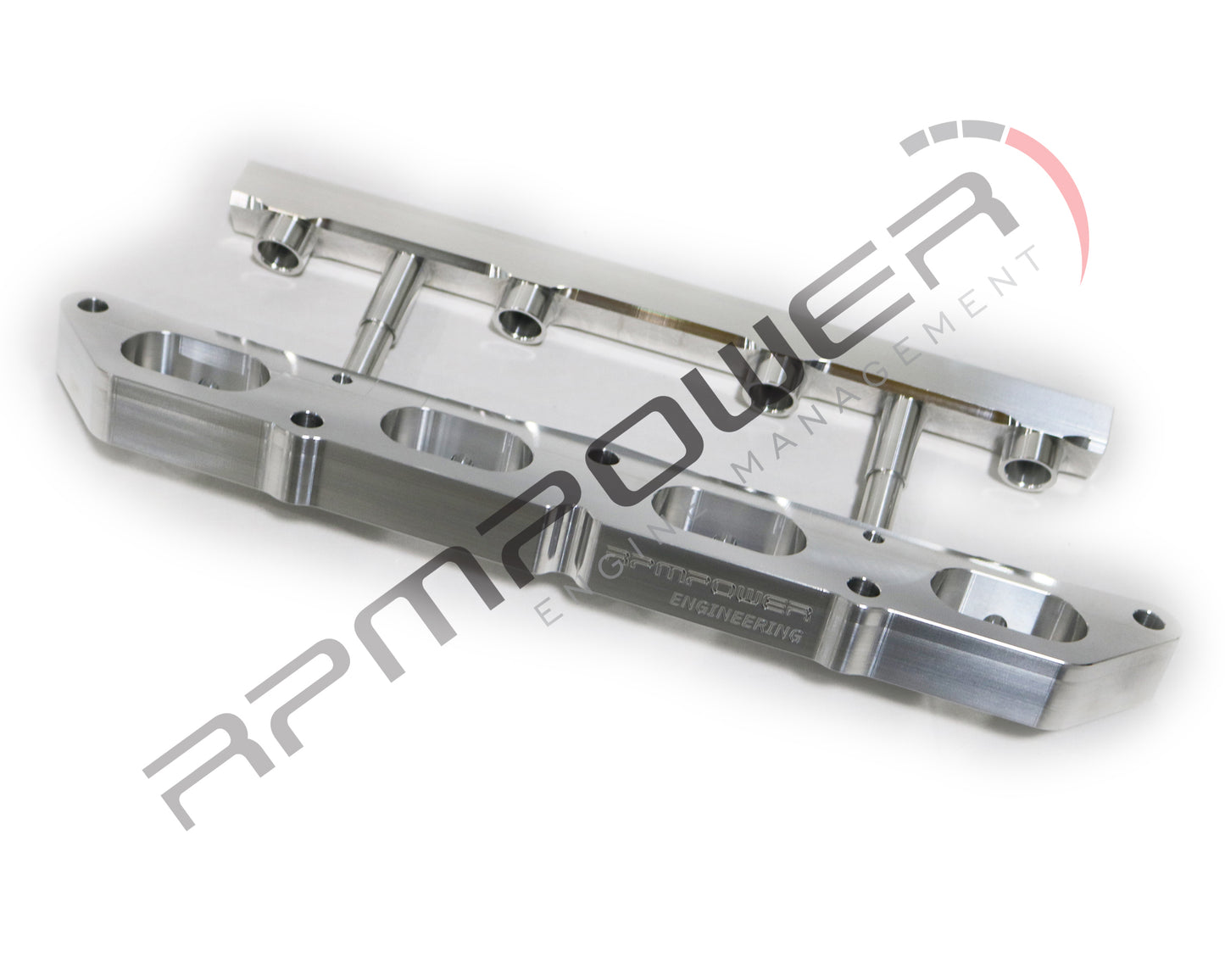
- Port fuel sandwich plate
- Fuel rails
- Installation bolts (x5)
- Fuel rail bolts (x2)
- 5/16 EFI quick connect fitting and end cap
Please Note: Electronics are not included! We offer a full MPI package for the R400TS. If you have a custom project and require our assistance with port fuel integration and electronics, please contact us for further support. For those who know what to do, you can purchase this and carry on with your project!
Manufactured in Canada